
About
Family can be a difficult subject. Sometimes it might even be better if it did not exist, as it can become too heavy a burden. Speaking about it is not easy either. Damian Kula has done so in his paintings. He received second prize at the Bielska Jesień 2025 competition.
I will not invoke the saying about where one supposedly looks best with one’s family. Everyone carries it somewhere at the back of their mind. A mind often burdened with family traumas, family memories, family obligations. At the same time, artistic strategies in response to family experience are frequently diverse, opposing, or even mutually exclusive.
For some, trauma is an unspoken taboo. For others, it becomes the subject of years of therapy. There are also those who use their own creative work as a form of therapy. Self-therapy can be remarkably effective. Many artists, including the greatest ones, whom I will not name, turn to such a solution, such an action, such a mode of creation. It may be dramatic, it may be joyful, it may be painstaking. It is never easy, even when images or words seem to flow freely and willingly. Apparent ease is often paid for with heavy and burdensome decisions, choices, and psychological constructions.
Damian Kula is sincere in his paintings. He is equally sincere in the self-commentary written for the exhibition DoZrastanie. He writes:
“I very much wanted my father to be proud of me, so by sheer force of will I managed to switch off pain, any pain. I quickly stopped crying, and even more quickly I stopped reacting to what hurt me. There is no pain. What had once been a tool to please my strict father became part of my personality.”
The figure of the father. The great presence. The great absence. Physically he has now disappeared. Yet he remains a major subject of thought and art. Years ago, I read Franz Kafka’s Letter to His Father. I was in high school at the time. I had no problem with my father. My problem was my mother, cold and punitive. I therefore substituted her figure for the father addressed in Kafka’s letter. Let me quote one fragment:
“It is also true that you never really beat me. But your shouting, your flushed face, the hurried unbuckling of your suspenders, their hanging in readiness over the back of the chair, were for me almost worse. It was as if someone were about to be hanged.”
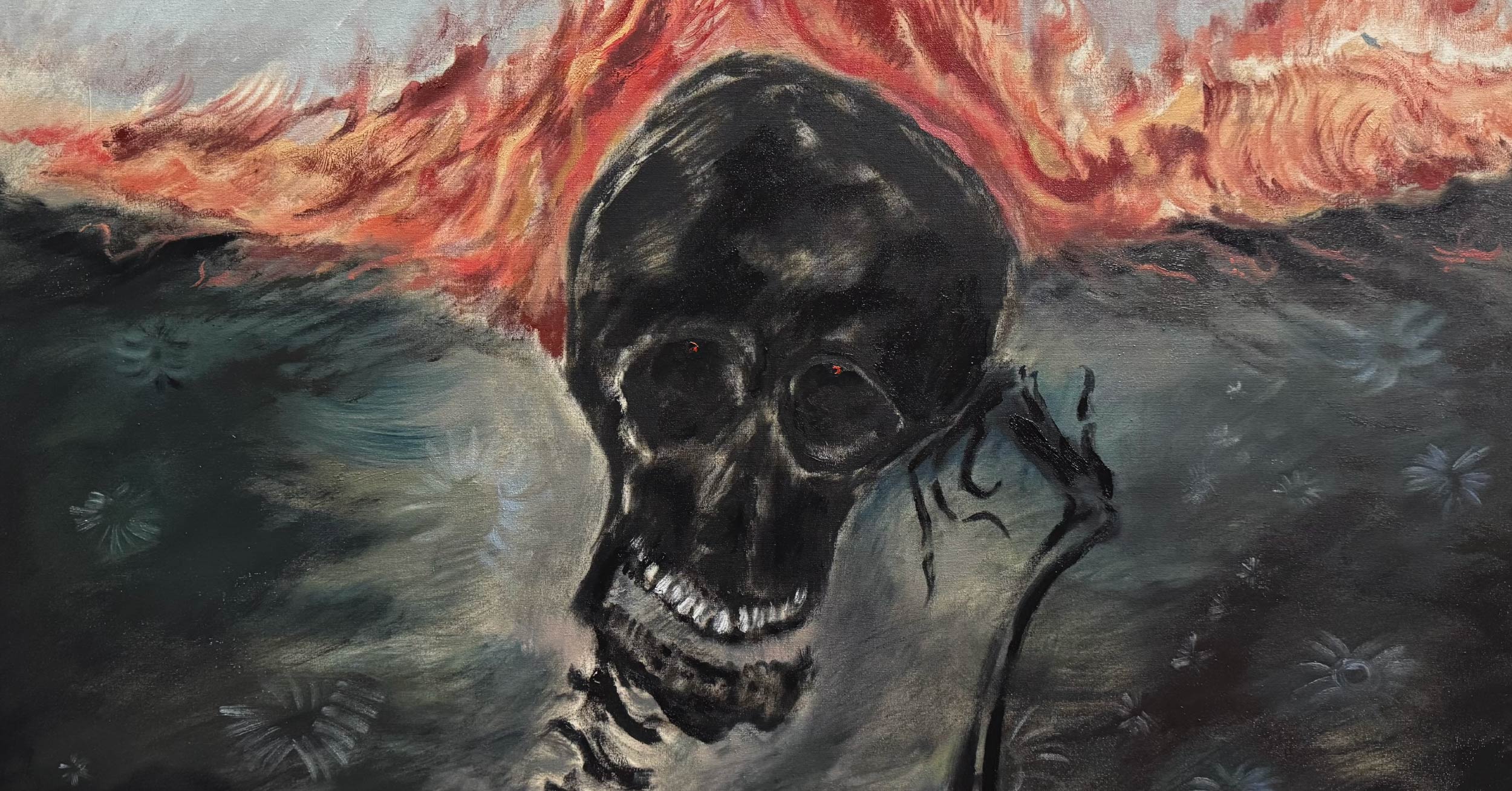
Damian Kula’s paintings resemble a burned-out site. Scorched in colour, scorched in emotion, yet still searing. Smouldering with themes and feelings. With anger and resignation. What can be done with a past about which nothing can be done? It can be spoken, shouted out, painted.
A father who is meant to be a support but becomes an obstacle. A bone in the throat. A disturbance of order, the end of order. And then the absence of the mother. The mother is nowhere to be seen. She has vanished. Evaporated. Slipped out of this world. Does death become the mother? There is much of it here, whether in the form of a skull, a whole skeleton, or even withered little hands. Skeletons, bones, the dead appear frequently in these paintings.
There is also, for instance, a variation on the story of William Tell, in which the son had to trust his father’s skill with the bow. Or two childhood scenes: in one, the father witnesses his son drowning at sunset; in another, he helps him urinate at sunrise. Dark dogs also appear, or rather, as in the title of Ian McEwan’s novel, Black Dogs. And looking at Kula’s unsettling images, I am reminded of the title of that English writer’s debut collection, First Love, Last Rites. There, too, things were dark and unexpected, just as they are in Kula’s paintings.
Some of the works are animated by the artist’s own imagination or iconography. A youth whose arms are entwined with snakes. A seated figure confronted by a procession of dancing skeletons. An oversized strongman hurling a skeleton. I would like greater access to the young painter’s imaginative world, but it feels awkward to ask about everything, and not everything can be deciphered. And what is this titular DoZrastanie — growing up intertwined with growing together? Is it about merging with one’s own family, or about breaking through to oneself? I ask and do not wait for an answer.
Display


